Ordering Update | Ordering has moved to representative consultation. Submit your selection and our representative Rob will follow up with pricing, availability, and next steps. Questions? rob@agefix.shop
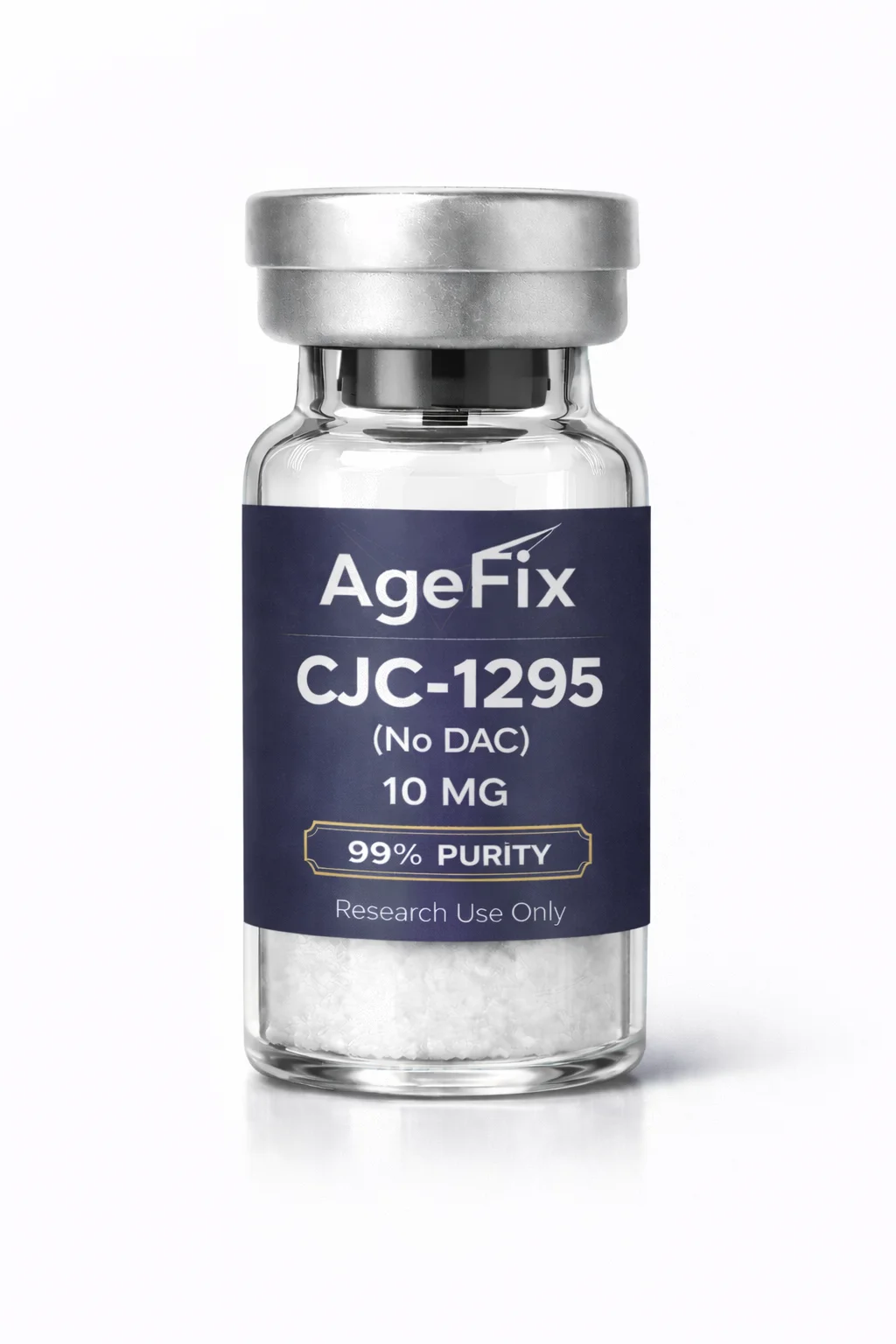
$ 89 / 10mg
998 in stock (can be backordered)
CJC-1295 No DAC (also known as Modified GRF 1-29) is a 29-amino-acid modified growth-hormone-releasing hormone (GHRH) analogue widely used in preclinical research to study pulsatile growth-hormone secretion, GH-axis dynamics, and metabolic regulation. Unlike the DAC-conjugated version that produces sustained GH elevation over days, CJC-1295 No DAC generates short, physiological GH pulses that closely mimic the body’s natural secretion pattern.
CJC-1295 No DAC binds to growth-hormone-releasing hormone receptors (GHRH-R) on anterior pituitary somatotroph cells, activating adenylate cyclase and increasing intracellular cyclic AMP (cAMP). This triggers calcium-dependent exocytosis of stored growth hormone granules, producing a GH pulse that peaks within 30 minutes and returns to baseline within 2-3 hours. The peptide’s four amino-acid substitutions (Ala2, Gln8, Ala15, Leu27) provide enhanced resistance to dipeptidyl peptidase-IV (DPP-IV) cleavage compared to native GHRH.
This mechanism preserves the hypothalamic-pituitary negative-feedback loop — when GH levels rise, somatostatin release increases to suppress further GH secretion. Researchers value this feedback preservation because it allows the study of GH-axis dynamics under near-physiological conditions, as documented in studies by Ionescu and Bhatt (2006) in Endocrinology Reviews examining modified GHRH analogues.
The key difference between CJC-1295 No DAC and the DAC-conjugated version lies in pharmacokinetics. The Drug Affinity Complex (DAC) binds to serum albumin, extending the half-life to 6-8 days and producing continuously elevated GH levels. CJC-1295 No DAC, without this albumin-binding modification, produces discrete GH pulses lasting 2-3 hours — more closely resembling endogenous GHRH signaling. Most current GH-axis research favors the No DAC variant because chronic GH elevation can downregulate GH receptors and confound experimental results.
CJC-1295 No DAC is a primary research tool for studying the GHRH-GH-IGF-1 axis. Its pulsatile release profile allows researchers to examine GH pulse amplitude, frequency, and feedback regulation under controlled conditions — essential for understanding somatopause (age-related GH decline) and pituitary function.
Pulsatile GH release driven by CJC-1295 No DAC stimulates hepatic IGF-1 production, which mediates downstream effects on protein synthesis, lipolysis, and lean-mass maintenance. Researchers use this peptide to study the metabolic effects of restored GH pulsatility in aging and metabolic-dysfunction models.
The largest natural GH pulse occurs during slow-wave sleep. CJC-1295 No DAC is used in research examining the relationship between GHRH-driven GH release and sleep architecture, including studies on how GH pulsatility affects sleep quality and recovery.
CJC-1295 No DAC is frequently combined with ghrelin-receptor agonists because GHRH and ghrelin activate GH release through independent receptor pathways. This dual stimulation produces amplified GH pulses that exceed what either compound achieves alone.
Each vial contains 10 mg of CJC-1295 No DAC peptide manufactured in the USA under ISO-certified conditions. Every batch is verified to ≥99% purity by HPLC analysis, screened for endotoxin levels below 0.1 EU/mg, and supplied with a full Certificate of Analysis (COA) available upon request. Shipped lyophilized for maximum stability. Reconstitute with bacteriostatic water and store at 2–8°C. For laboratory research use only — not for human consumption.
CJC-1295 No DAC is supplied as a lyophilized (freeze-dried) powder for optimal long-term stability. Store unopened vials at -20°C in a dry, light-protected environment. When ready for experimental use, reconstitute with bacteriostatic water using sterile technique. After reconstitution, store the peptide solution at 2–8°C and use within 28 days to preserve structural integrity and receptor-binding activity. Avoid repeated freeze-thaw cycles, as these can fragment the modified GHRH sequence and reduce biological potency. Handle using standard laboratory PPE and aseptic protocols. For research use only.
The CJC-1295 peptide family was originally developed by ConjuChem Biotechnologies (Montreal, Canada) in the early 2000s as a long-acting GHRH analogue. The “No DAC” variant — also designated Modified GRF(1-29) — retains the four key amino-acid substitutions that confer DPP-IV resistance but omits the Drug Affinity Complex used in the original formulation. Early pharmacokinetic studies were published by Ionescu and Bhatt (2006) characterizing modified GHRH analogues in clinical settings. Since then, CJC-1295 No DAC has appeared in dozens of peer-reviewed publications examining GH-axis dynamics, pulsatile hormone secretion, and somatotroph physiology, with research groups at universities across North America, Europe, and Australia contributing to the literature. The peptide is referenced extensively in endocrinology reviews covering age-related GH decline (somatopause). This compound is sold for laboratory research use only.
Every batch of CJC-1295 No DAC is verified to ≥99% purity by high-performance liquid chromatography (HPLC) and screened for endotoxin levels below 0.1 EU/mg. Each order ships with access to a full Certificate of Analysis (COA) confirming identity, purity, and sterility for research use only.
Both are GHRH analogues, but CJC-1295 No DAC has four amino-acid substitutions that confer greater resistance to DPP-IV enzymatic degradation, resulting in a longer active window of 2–3 hours compared to Sermorelin’s shorter half-life. This makes CJC-1295 No DAC better suited for research protocols requiring sustained pulsatile GH stimulation in laboratory models.
Yes, CJC-1295 No DAC is frequently paired with ghrelin-receptor agonists such as Ipamorelin in preclinical studies because they activate GH release through independent receptor pathways. This dual-pathway approach has been observed to produce amplified GH pulses exceeding what either compound achieves alone in research settings. This product is for research use only.
We use cookies to enhance your browsing experience, provide personalized content, and improve site performance. For the best experience, please keep your browser up to date — latest browser update.