Ordering Update | Ordering has moved to representative consultation. Submit your selection and our representative Rob will follow up with pricing, availability, and next steps. Questions? rob@agefix.shop
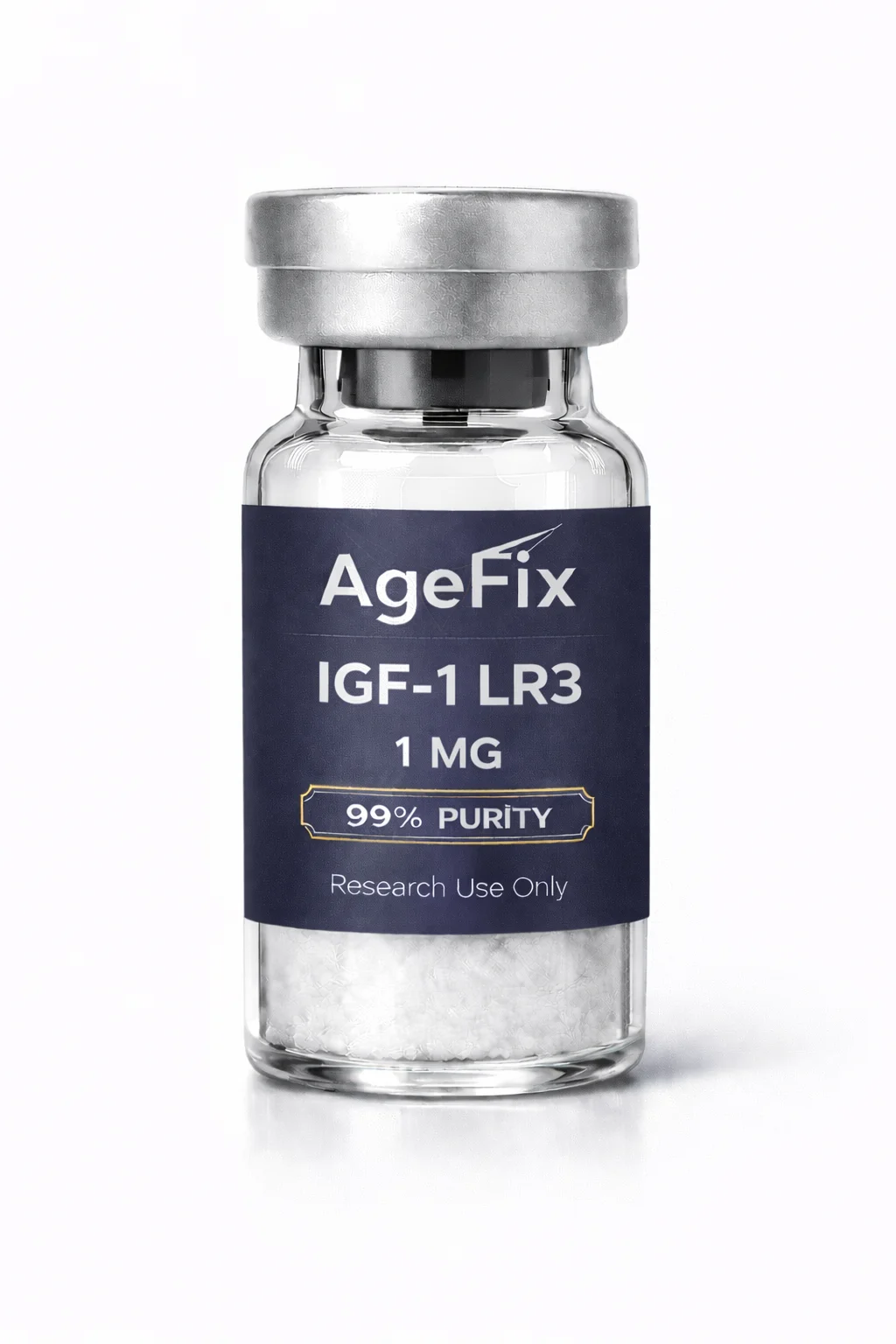
$ 89 / 1mg
999 in stock (can be backordered)
IGF-1 LR3 (Long Arg3 Insulin-Like Growth Factor-1) is an 83-amino-acid analogue of native IGF-1, engineered with an arginine substitution at position 3 and a 13-amino-acid N-terminal extension. These modifications reduce IGF-binding-protein affinity, resulting in significantly longer biological activity compared to native IGF-1. IGF-1 LR3 peptide is widely used in cell-culture and animal models to study muscle hypertrophy, cell proliferation, and metabolic signaling.
IGF-1 LR3 peptide activates the IGF-1 receptor (IGF-1R), triggering the PI3K/Akt and MAPK/ERK signaling cascades that regulate cell growth, differentiation, and survival. Because it has reduced affinity for IGF-binding proteins (IGFBPs), a higher fraction remains bioavailable in circulation — producing more potent and prolonged receptor activation than native IGF-1. This makes it particularly useful in studies requiring sustained anabolic signaling.
IGF-1 LR3 is often studied alongside GH-releasing peptides that stimulate endogenous IGF-1 production. CJC-1295 + Ipamorelin drives pulsatile GH release upstream of IGF-1, while Tesamorelin offers a GHRH-analogue approach. For muscle-specific research, AOD9604 targets the fat-metabolism component of body composition.
Each vial contains IGF-1 LR3 peptide manufactured in the USA under ISO-certified conditions. Verified to ≥99% purity by HPLC analysis, with endotoxin screening below 0.1 EU/mg. Certificate of Analysis (COA) available upon request. For laboratory research use only.
IGF-1 LR3 is supplied as a lyophilized (freeze-dried) powder to preserve maximum peptide stability. Store unopened vials at -20°C in a dry, light-protected environment. Reconstitute with bacteriostatic water or sterile 0.1M acetic acid using aseptic technique when ready for experimental use. After reconstitution, store the solution at 2–8°C and use within 28 days to maintain receptor-binding activity and structural integrity. Avoid repeated freeze-thaw cycles, as these can denature the 83-amino-acid sequence and reduce biological potency. Handle with appropriate laboratory PPE. For research use only.
IGF-1 LR3 was developed as a research tool to overcome the limitations of native IGF-1, which is rapidly sequestered by six known IGF-binding proteins (IGFBP-1 through IGFBP-6) in circulation. The original IGF-1 protein was first characterized in the 1970s by researchers including Rinderknecht and Humbel, who identified its structural similarity to proinsulin. The LR3 variant was engineered in the late 1980s and early 1990s by modifying the N-terminal region to reduce IGFBP binding, resulting in dramatically increased bioavailability. Since then, IGF-1 LR3 has been referenced in hundreds of peer-reviewed publications spanning journals such as Endocrinology, the Journal of Biological Chemistry, and Growth Hormone & IGF Research. Major research institutions including the Garvan Institute of Medical Research in Australia have contributed key studies on its anabolic and mitogenic signaling properties. This compound is sold for laboratory research use only.
Each batch of IGF-1 LR3 is verified to ≥99% purity by high-performance liquid chromatography (HPLC) and undergoes endotoxin screening to ensure levels remain below 0.1 EU/mg. A full Certificate of Analysis (COA) is available upon request, documenting identity, purity, and sterility for research documentation.
IGF-1 LR3 features an arginine substitution at position 3 and a 13-amino-acid N-terminal extension that significantly reduce binding to IGF-binding proteins (IGFBPs). This results in a higher fraction of bioavailable peptide and more prolonged IGF-1 receptor activation, making it the preferred analogue for research protocols requiring sustained anabolic signaling in cell-culture and animal models.
IGF-1 LR3 activates the IGF-1 receptor (IGF-1R), triggering both the PI3K/Akt and MAPK/ERK signaling cascades involved in cell growth, differentiation, survival, and metabolic regulation. These pathways are central to research on muscle hypertrophy, satellite-cell activation, and anti-apoptosis signaling. This product is for laboratory research use only.
We use cookies to enhance your browsing experience, provide personalized content, and improve site performance. For the best experience, please keep your browser up to date — latest browser update.