Ordering Update | Ordering has moved to representative consultation. Submit your selection and our representative Rob will follow up with pricing, availability, and next steps. Questions? rob@agefix.shop
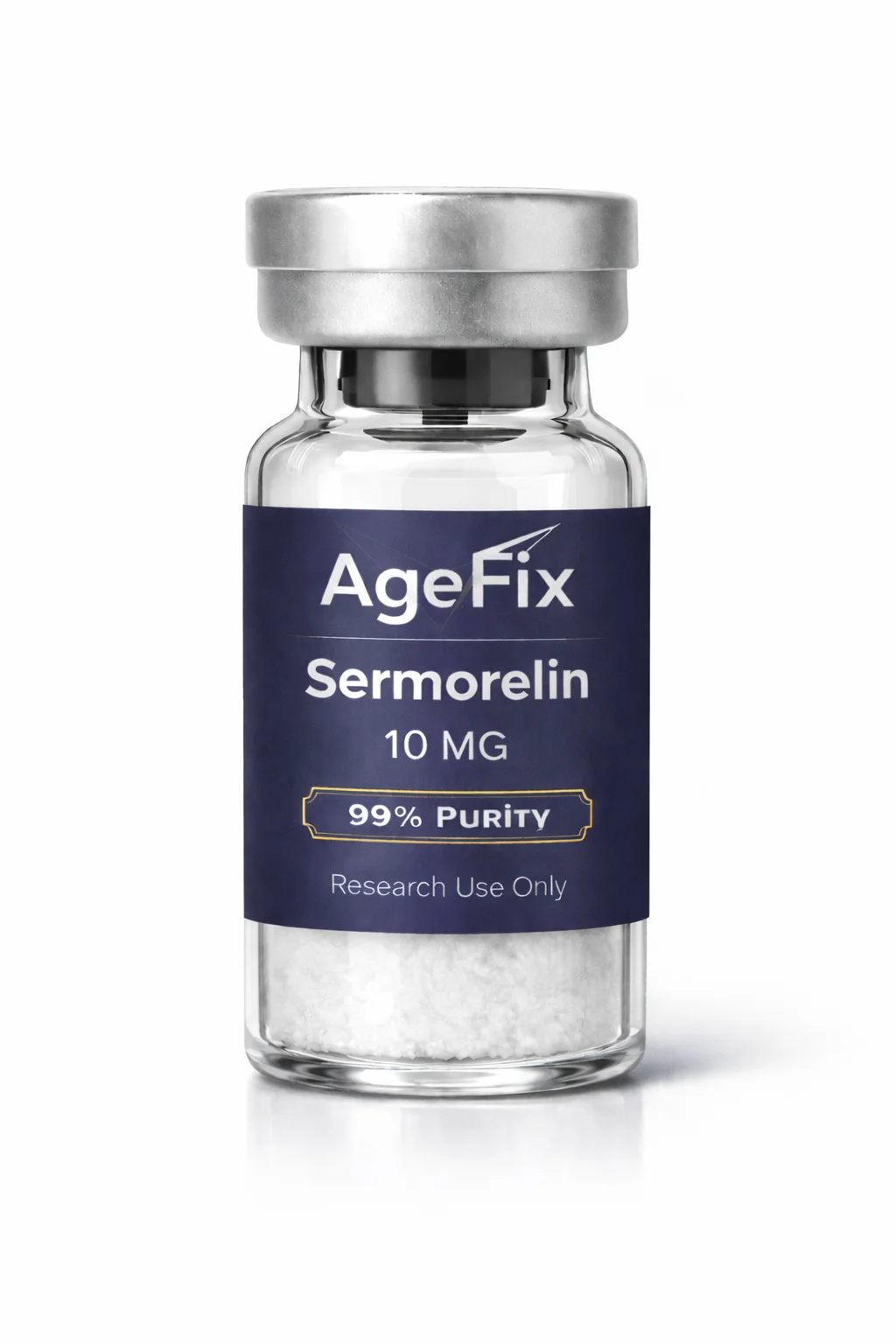
$ 79 / 10mg
999 in stock (can be backordered)
Sermorelin Acetate is a synthetic 29-amino-acid analogue of endogenous growth hormone-releasing hormone (GHRH 1-29), representing the shortest fully functional GHRH fragment. As one of the first GHRH analogues developed for research, Sermorelin peptide has an extensive published literature base examining pulsatile GH release, pituitary function, and age-related endocrine decline. It remains a reference standard in GH-axis research.
Sermorelin peptide binds to GHRH receptors on pituitary somatotroph cells, activating adenylate cyclase and cAMP-dependent GH release. It produces natural, pulsatile GH secretion patterns that preserve the hypothalamic-pituitary feedback loop — a key advantage over exogenous GH administration in research models. Its relatively short half-life (10-20 minutes) makes it useful for studying acute GH-pulse dynamics and circadian secretion patterns.
CJC-1295 (No DAC) offers a longer-acting GHRH analogue for extended-release comparison studies. The CJC-1295 + Ipamorelin combination adds ghrelin-receptor activation for dual-pathway research. Tesamorelin provides a GHRH analogue specifically studied for visceral-fat metabolism.
Each vial contains Sermorelin Acetate peptide manufactured in the USA under ISO-certified conditions. Verified to ≥99% purity by HPLC analysis, with endotoxin screening below 0.1 EU/mg. Certificate of Analysis (COA) available upon request. For laboratory research use only.
Lyophilized Sermorelin peptide should be stored at -20°C in a sealed container protected from light and moisture for long-term stability. Reconstitute with bacteriostatic water by gently swirling the vial — never shake, as agitation can degrade peptide bonds. Once reconstituted, store at 2–8°C (standard laboratory refrigeration) and use within 28 days. Due to Sermorelin’s relatively short half-life, researchers should prepare aliquots for individual experiments to minimize repeated freeze-thaw cycles that may reduce peptide integrity. Always use sterile technique when withdrawing from reconstituted vials. For research use only.
Sermorelin was first characterized in the early 1980s when researchers identified that the first 29 amino acids of the 44-amino-acid GHRH molecule retained full biological activity. It was developed at Tulane University and the Salk Institute, with early studies by researchers including Andrew Schally and Roger Guillemin establishing the GHRH signaling framework. Sermorelin has since accumulated over 500 peer-reviewed publications in PubMed, making it one of the most extensively documented GHRH analogues in the literature. Key research programs at the National Institutes of Health, Johns Hopkins University, and the Mayo Clinic have examined its role in pituitary diagnostics and age-related GH decline. It has served as a foundational reference compound against which newer GHRH analogues are benchmarked. All referenced research pertains to preclinical and laboratory investigations.
AgeFix Sermorelin Acetate is verified to ≥99% purity by HPLC analysis and undergoes endotoxin screening to confirm levels below 0.1 EU/mg. Each batch is manufactured in the USA under ISO-certified conditions, and a Certificate of Analysis (COA) is available upon request.
Sermorelin stimulates the pituitary to produce natural, pulsatile GH secretion patterns that preserve the hypothalamic-pituitary feedback loop, unlike direct GH administration which bypasses this axis. This makes it particularly valuable for studying endogenous GH regulation and age-related somatopause in research settings.
Sermorelin should be reconstituted with bacteriostatic water by gently swirling — never shaking — and stored at 2–8°C after reconstitution. Reconstituted Sermorelin is intended for research use only and should be used within 28 days of reconstitution to maintain peptide stability.
We use cookies to enhance your browsing experience, provide personalized content, and improve site performance. For the best experience, please keep your browser up to date — latest browser update.