Ordering Update | Ordering has moved to representative consultation. Submit your selection and our representative Rob will follow up with pricing, availability, and next steps. Questions? rob@agefix.shop
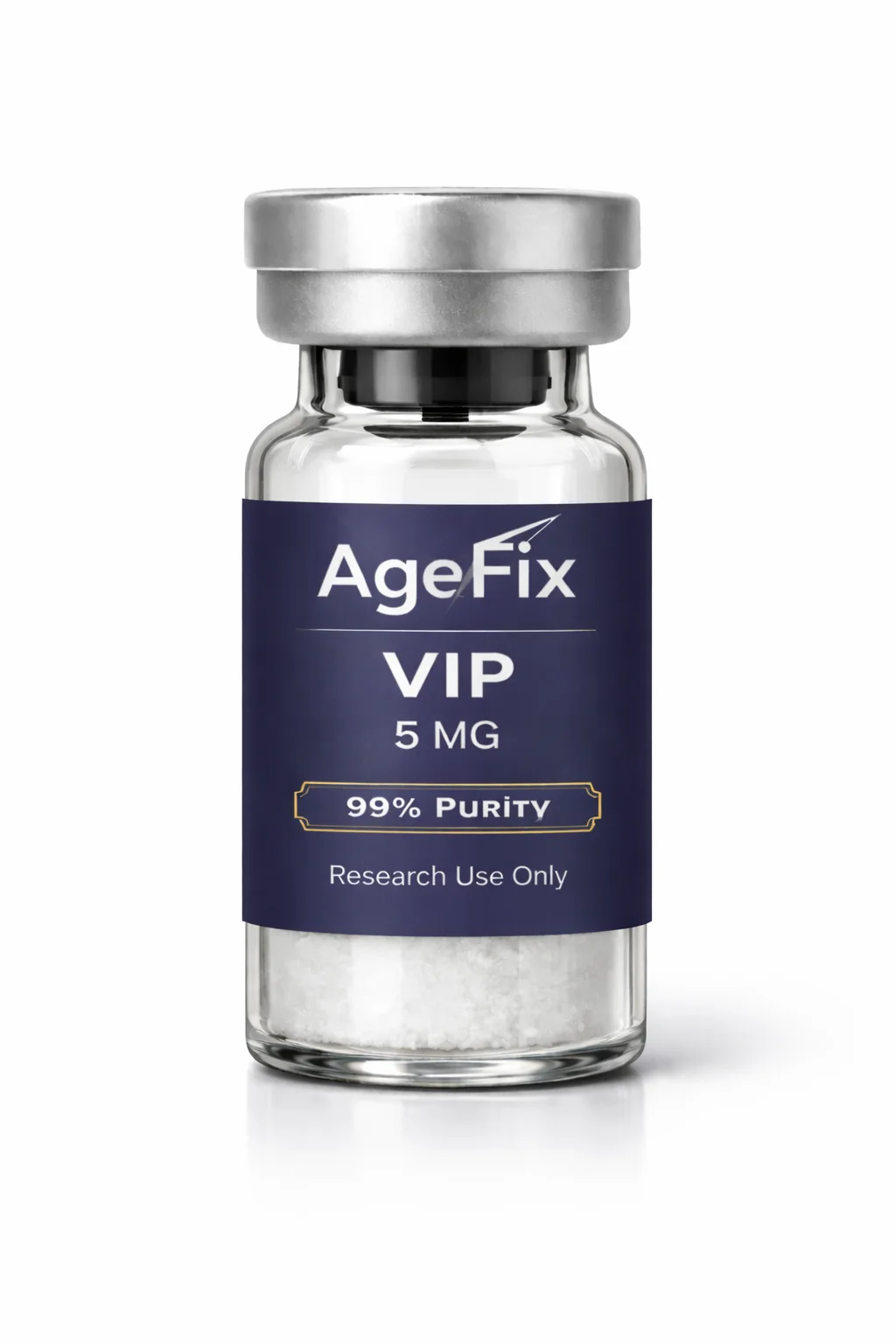
$ 69 / 5mg
998 in stock (can be backordered)
VIP (Vasoactive Intestinal Peptide) is a 28-amino-acid neuropeptide widely distributed throughout the central and peripheral nervous systems, gastrointestinal tract, and immune tissues. VIP peptide activates VPAC1 and VPAC2 receptors to regulate vasodilation, smooth-muscle relaxation, neuroimmune signaling, and gut-brain axis communication. With over 8,000 published studies, VIP is one of the most extensively characterized neuropeptides in biomedical research.
VIP peptide binds VPAC1 and VPAC2 G-protein-coupled receptors, activating adenylate cyclase and increasing intracellular cAMP. This triggers vasodilation through smooth-muscle relaxation, modulates pro-inflammatory cytokine production (reducing TNF-α, IL-6, and IL-12), and influences neurotransmitter release in enteric and central neurons. In gut-brain axis research, VIP regulates intestinal motility, epithelial ion transport, and mucosal immune responses — connecting gastrointestinal function with central nervous system signaling.
BPC-157 targets gut-healing through gastric-peptide mechanisms complementary to VIP’s enteric signaling. KPV offers NF-κB-mediated gut anti-inflammatory research. SS-31 provides mitochondrial-level support for tissues affected by VIP-mediated metabolic regulation.
Each 5 mg vial contains VIP peptide manufactured in the USA under ISO-certified conditions. Verified to ≥99% purity by HPLC analysis, screened for endotoxin levels below 0.1 EU/mg. Certificate of Analysis (COA) available upon request. For laboratory research use only.
Lyophilized VIP peptide should be stored at -20°C in a sealed container protected from light and moisture to maintain long-term stability. For reconstitution, use bacteriostatic water and gently swirl the vial until fully dissolved — never shake. Once reconstituted, store at 2–8°C (standard laboratory refrigeration) and use within 28 days. VIP is a relatively large neuropeptide (28 amino acids) that benefits from careful handling to preserve tertiary structure, so researchers should prepare aliquots and minimize freeze-thaw cycles. Always use sterile technique when withdrawing from reconstituted vials. For research use only.
VIP was first isolated and characterized in 1970 by Sami Said and Viktor Mutt at the Karolinska Institute in Stockholm, Sweden, from porcine intestinal extracts. The peptide was named for its potent vasodilatory effects observed during initial characterization. Since its discovery over five decades ago, VIP has accumulated more than 8,000 peer-reviewed publications in PubMed, establishing it as one of the most studied neuropeptides in biomedical science. Major contributions to VIP research have come from laboratories at the Karolinska Institute, the National Institutes of Health, UCLA, and the Weizmann Institute of Science. Research has expanded from its original vascular focus to encompass neuroimmunology, circadian biology, and gut-brain axis signaling. VIP continues to serve as a reference neuropeptide in studies of VPAC receptor pharmacology and enteric nervous system function. All referenced work pertains to preclinical and laboratory research settings.
AgeFix VIP peptide is verified to ≥99% purity by HPLC analysis and screened for endotoxins to confirm levels below 0.1 EU/mg. Each batch is manufactured in the USA under ISO-certified conditions, with a Certificate of Analysis (COA) available upon request for research documentation.
VIP activates both VPAC1 and VPAC2 receptors across neural, immune, and gastrointestinal tissues, giving it one of the broadest functional profiles of any neuropeptide. This makes it a key reference compound for studying the gut-brain axis, circadian rhythm regulation, and neuroimmune crosstalk in laboratory models.
VIP should be reconstituted with bacteriostatic water by gently swirling until fully dissolved, then stored at 2–8°C and used within 28 days. Lyophilized VIP should be stored at -20°C for long-term stability. This product is for laboratory research use only.
We use cookies to enhance your browsing experience, provide personalized content, and improve site performance. For the best experience, please keep your browser up to date — latest browser update.