Ordering Update | Ordering has moved to representative consultation. Submit your selection and our representative Rob will follow up with pricing, availability, and next steps. Questions? rob@agefix.shop
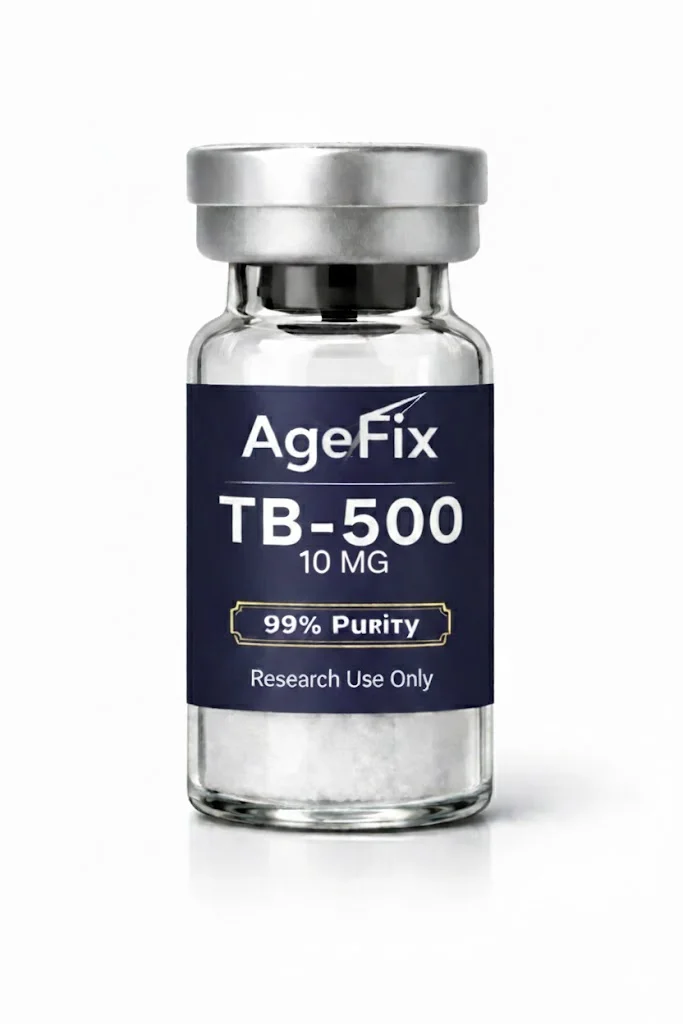
$ 99 / 10mg
998 in stock (can be backordered)
TB-500 is a synthetic 43-amino-acid peptide fragment corresponding to the active region of Thymosin Beta-4, one of the most abundant intracellular peptides in mammalian cells. TB-500 peptide is extensively studied in preclinical models for its roles in tissue repair, cell migration, angiogenesis, and inflammation modulation. Its primary mechanism — promoting actin polymerization and cytoskeletal reorganization — underpins its effects across multiple tissue types.
TB-500 peptide sequesters G-actin monomers, regulating the polymerization-depolymerization balance critical for cell motility and migration. In wound-healing models, this promotes fibroblast, keratinocyte, and endothelial cell migration into damaged tissue. Additionally, TB-500 has been studied for downregulating pro-inflammatory cytokines (IL-1β, TNF-α) and upregulating anti-inflammatory mediators — creating a favorable environment for tissue remodeling rather than scar formation.
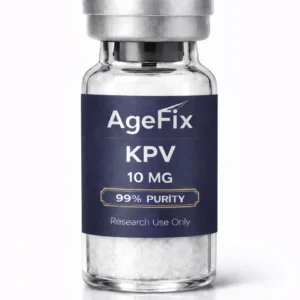
BPC-157 targets complementary repair pathways through gastric-peptide mechanisms. The BPC-157 + TB-500 combination (“Wolverine Stack”) is the most popular pairing for multi-pathway repair research. KPV provides NF-κB-mediated anti-inflammatory signaling for inflammation-focused studies.
Each 10 mg vial contains TB-500 peptide manufactured in the USA under ISO-certified conditions. Verified to ≥99% purity by HPLC analysis, screened for endotoxin levels below 0.1 EU/mg. Certificate of Analysis (COA) available upon request. For laboratory research use only.
Lyophilized TB-500 peptide should be stored at -20°C in a sealed container protected from light and moisture for long-term stability. For reconstitution, use bacteriostatic water and gently swirl the vial until fully dissolved — never shake, as TB-500’s actin-binding properties make it sensitive to mechanical stress. Once reconstituted, store at 2–8°C (standard laboratory refrigeration) and use within 28 days. Researchers conducting extended tissue-repair assays should prepare single-use aliquots to avoid repeated freeze-thaw cycles that may reduce biological activity. Always use sterile technique when withdrawing from reconstituted vials. For research use only.
Thymosin Beta-4, the parent molecule of TB-500, was first isolated from calf thymus in 1981 by Allan Goldstein’s group at George Washington University as part of the Thymosin Fraction 5 characterization program. Its role as the primary G-actin-sequestering peptide in eukaryotic cells was elucidated in the 1990s by researchers including Evangelia Vartiainen and colleagues working on cytoskeletal biology. TB-500 — the synthetic active fragment — has since been the subject of over 200 peer-reviewed publications in PubMed spanning wound healing, cardiac repair, ophthalmology, and neuroscience. Major research contributions have come from the National Institutes of Health, the National Eye Institute, and laboratories at Johns Hopkins University and the University of Pittsburgh. The compound has been studied in equine veterinary research models as well as standard rodent preclinical paradigms, providing a broad translational evidence base. All referenced work pertains to preclinical and laboratory research settings.
AgeFix TB-500 is verified to ≥99% purity by HPLC analysis and screened for endotoxin levels below 0.1 EU/mg. Each 10 mg vial is manufactured in the USA under ISO-certified conditions, with a Certificate of Analysis (COA) available upon request for research records.
The “Wolverine Stack” refers to the BPC-157 + TB-500 combination, which is the most widely studied multi-pathway tissue repair pairing in preclinical research. TB-500 promotes cell migration through actin regulation while BPC-157 works through gastric-peptide repair mechanisms, providing complementary pathways for tissue-healing assays in research settings.
TB-500 should be reconstituted with bacteriostatic water by gently swirling until fully dissolved, then stored at 2–8°C and used within 28 days. Unreconstituted lyophilized TB-500 should be stored at -20°C. This product is for laboratory research use only and is not intended for human use.
We use cookies to enhance your browsing experience, provide personalized content, and improve site performance. For the best experience, please keep your browser up to date — latest browser update.