Ordering Update | Ordering has moved to representative consultation. Submit your selection and our representative Rob will follow up with pricing, availability, and next steps. Questions? rob@agefix.shop
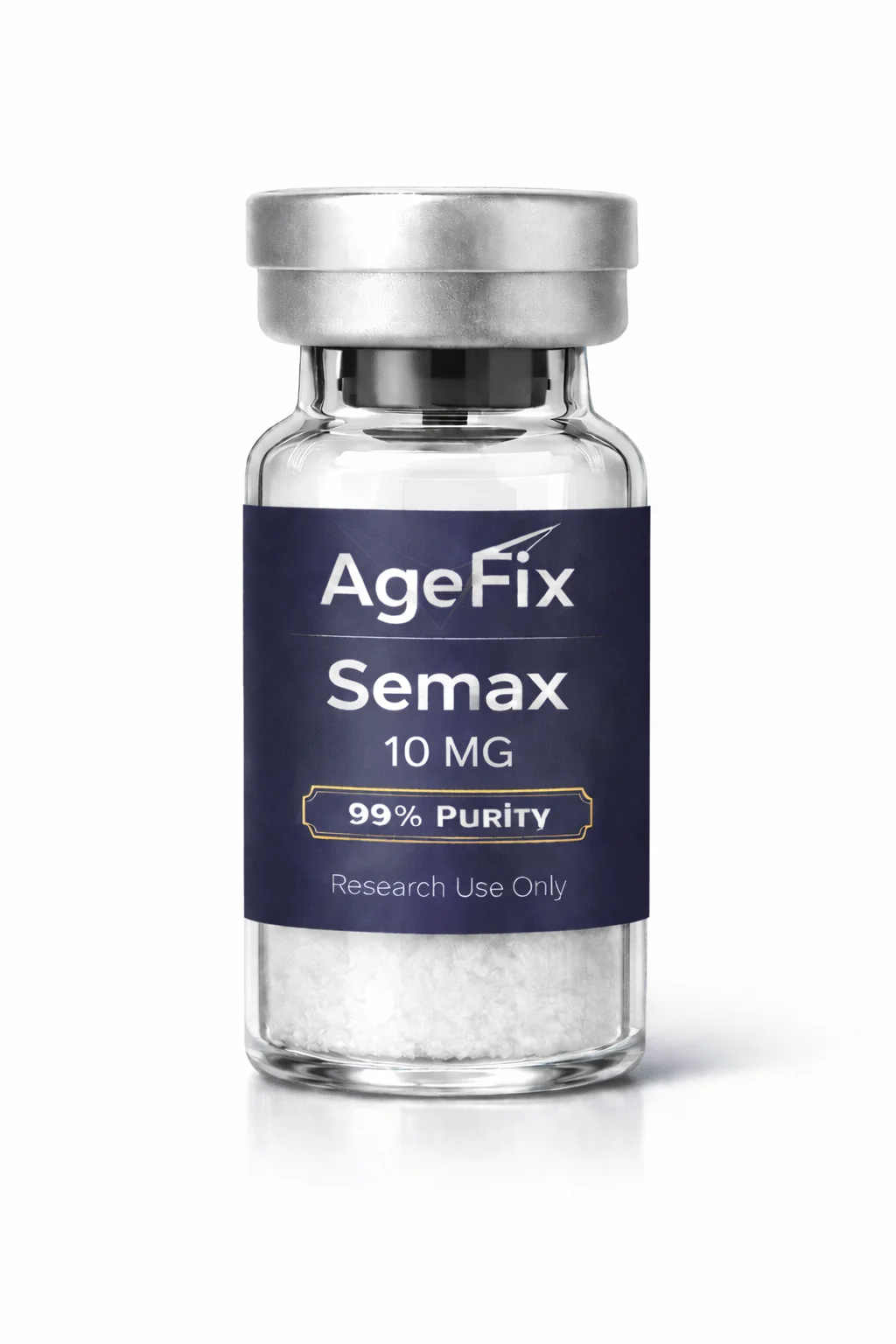
$ 49 / 10mg
997 in stock (can be backordered)
Semax Amidate is a stabilized synthetic heptapeptide analogue of the adrenocorticotropic hormone (ACTH) fragment 4-10, developed at the Institute of Molecular Genetics (Russian Academy of Sciences). Semax peptide is one of the most extensively studied nootropic peptides, with research examining its effects on BDNF expression, cognitive function, neuroplasticity, and neuroprotection. The amidate modification provides enhanced enzymatic stability for consistent research results.
Semax peptide increases expression of brain-derived neurotrophic factor (BDNF) and its receptor TrkB, promoting neuronal survival, synaptic plasticity, and long-term potentiation. It also modulates dopaminergic and serotonergic neurotransmission and has been studied for effects on NGF (nerve growth factor) expression. Unlike ACTH itself, Semax does not stimulate adrenal corticosteroid production — its neuroactive effects are independent of the HPA axis.
Selank is Semax’s complementary counterpart — targeting anxiolytic and immunomodulatory pathways. PE-22-28 offers ECM-signaling research for broader neuropeptide studies, while NAD+ supports the metabolic-energy side of neuronal function and longevity.
Each vial contains Semax Amidate peptide manufactured in the USA under ISO-certified conditions. Verified to ≥99% purity by HPLC analysis, with endotoxin screening below 0.1 EU/mg. Certificate of Analysis (COA) available upon request. For laboratory research use only.
Lyophilized Semax Amidate peptide should be stored at -20°C in a sealed container protected from light and moisture for optimal long-term stability. Reconstitute with bacteriostatic water and store the solution at 2–8°C, using all reconstituted material within 28 days. Prepare single-use aliquots at the time of reconstitution to prevent degradation from repeated freeze-thaw cycles. Follow standard aseptic laboratory handling procedures throughout preparation and use. This product is for laboratory research use only and is not intended for human consumption.
Semax was developed in the late 1980s at the Institute of Molecular Genetics of the Russian Academy of Sciences under the direction of Dr. Nikolai Myasoedov. The peptide was designed as a synthetic analogue of the ACTH(4-10) fragment with enhanced stability and neuroactive properties independent of adrenal stimulation. Over the past three decades, Semax has been the subject of more than 300 peer-reviewed publications in journals including Neuroscience Letters, Brain Research, and Doklady Biological Sciences. Research groups at the Russian Academy of Sciences, Moscow State University, and international institutions have extensively characterized its BDNF-upregulating and neuroprotective mechanisms. Semax remains one of the most thoroughly documented nootropic peptides in the preclinical neuroscience literature, serving as a benchmark compound in cognitive-enhancement and neuroprotection research.
The amidate modification on the C-terminus of Semax provides enhanced resistance to enzymatic degradation, resulting in greater metabolic stability and a longer effective window in research models. This makes Semax Amidate the preferred form for studies requiring consistent and sustained BDNF-modulation activity. Both forms are supplied for laboratory research use only.
Each batch is verified to ≥99% purity by HPLC analysis and undergoes endotoxin screening confirmed below 0.1 EU/mg, manufactured under ISO-certified conditions in the USA. A Certificate of Analysis (COA) with full analytical data is available upon request for research records.
Semax is derived from the ACTH(4-10) fragment but lacks the adrenal-stimulating properties of full-length ACTH, meaning it does not activate the HPA axis or increase cortisol production. Its nootropic effects operate through BDNF upregulation and monoaminergic neurotransmitter modulation instead. This compound is designated for research use only and is not intended for human therapeutic applications.
We use cookies to enhance your browsing experience, provide personalized content, and improve site performance. For the best experience, please keep your browser up to date — latest browser update.