Ordering Update | Ordering has moved to representative consultation. Submit your selection and our representative Rob will follow up with pricing, availability, and next steps. Questions? rob@agefix.shop
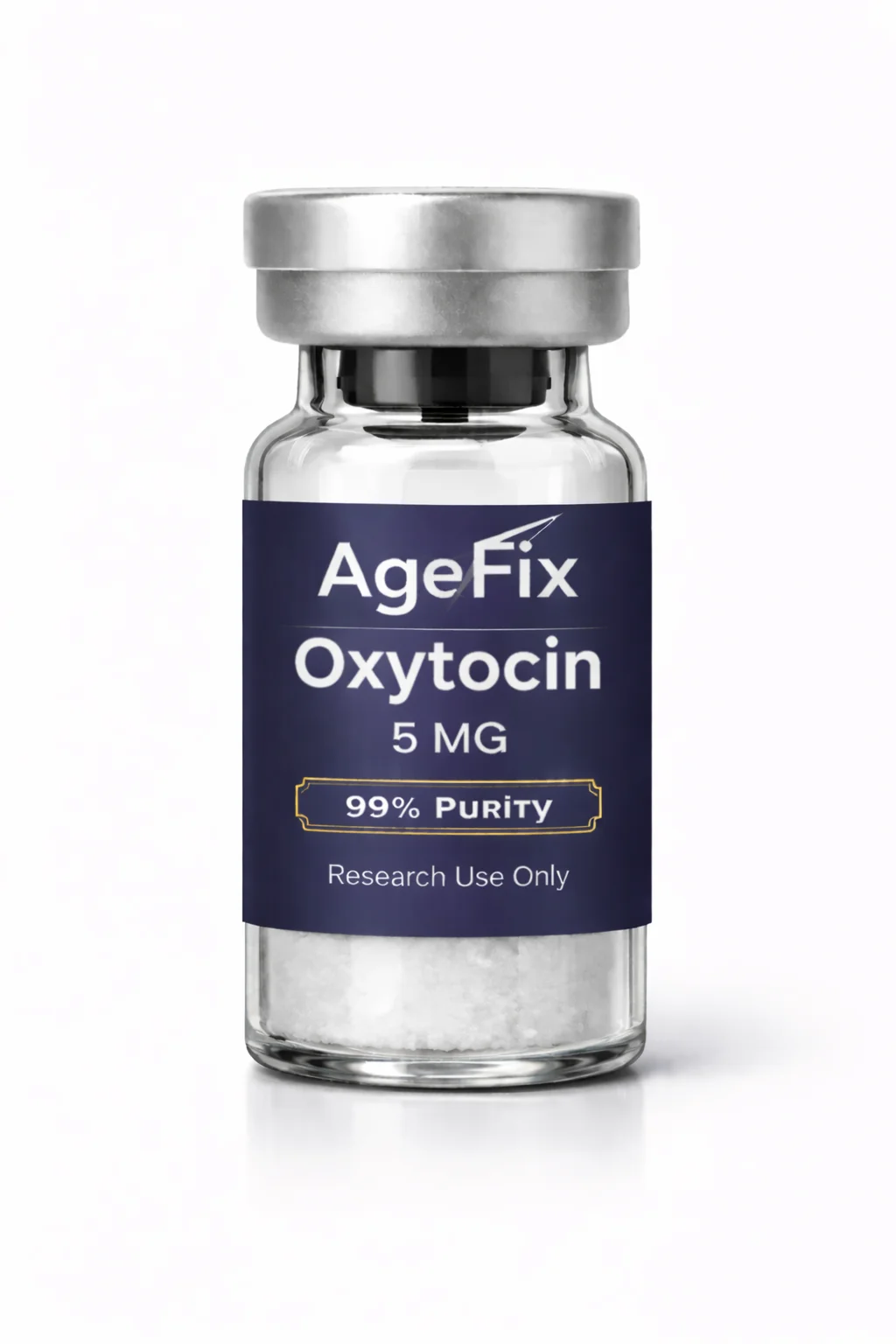
$ 59 / 5mg
999 in stock (can be backordered)
Oxytocin is a nine-amino-acid cyclic neuropeptide produced in the hypothalamus and released from the posterior pituitary, widely studied for its roles in social bonding, stress-response modulation, and neuroendocrine signaling. Often called the “bonding hormone,” Oxytocin peptide is one of the most researched neuropeptides in behavioral neuroscience, with applications spanning reproductive biology, psychiatric research, and cardiovascular studies.
Oxytocin peptide binds to oxytocin receptors (OXTR) — G-protein-coupled receptors expressed in the brain, heart, uterus, and other tissues. Central OXTR activation modulates GABAergic transmission, reduces amygdala reactivity, and increases social-reward signaling. Peripheral effects include uterine smooth-muscle contraction, milk ejection, and vasodilation. Research has shown that oxytocin-OXTR signaling reduces cortisol and HPA-axis activation in social stress models.
Researchers studying neuroendocrine and mood pathways often explore Oxytocin alongside Selank for anxiolytic peptide research, Semax for cognitive-enhancement models, and Kisspeptin for reproductive neuroendocrine signaling studies.
Each 5 mg vial contains Oxytocin peptide manufactured in the USA under ISO-certified conditions. Verified to ≥99% purity by HPLC analysis, with endotoxin screening below 0.1 EU/mg. Certificate of Analysis (COA) available upon request. For laboratory research use only.
Lyophilized Oxytocin peptide should be stored at -20°C in a sealed container protected from light and moisture for optimal long-term stability. The cyclic disulfide bond structure of Oxytocin makes it particularly sensitive to elevated temperatures, so cold-chain integrity is essential. Reconstitute with bacteriostatic water and store at 2–8°C, using all reconstituted material within 28 days. Prepare single-use aliquots to avoid repeated freeze-thaw cycles that may accelerate disulfide bond reduction. This product is for laboratory research use only and is not intended for human consumption.
Oxytocin was first isolated and structurally characterized in 1953 by Dr. Vincent du Vigneaud at Cornell University Medical College, work for which he received the Nobel Prize in Chemistry in 1955. It became the first polypeptide hormone to be synthesized in the laboratory. Since then, Oxytocin has become one of the most extensively studied neuropeptides in biomedical research, with over 20,000 peer-reviewed publications spanning journals such as Nature, Science, Psychoneuroendocrinology, and Biological Psychiatry. Research institutions worldwide — including the National Institute of Mental Health, the Max Planck Institute, and the University of Zürich — have contributed to understanding its roles in social cognition, stress physiology, and neuroendocrine regulation. Oxytocin remains the foundational reference compound in social neuroscience and bonding research.
Oxytocin binds to OXTR (oxytocin receptors), which are G-protein-coupled receptors expressed in the brain, cardiovascular system, and reproductive tissues. Central OXTR activation modulates GABAergic transmission and reduces amygdala reactivity, while peripheral activation influences smooth-muscle contraction and vasodilation. This product is supplied for laboratory research use only.
Each 5 mg vial is manufactured in the USA under ISO-certified conditions and verified to ≥99% purity by HPLC analysis, with endotoxin screening confirmed below 0.1 EU/mg. A Certificate of Analysis (COA) is available upon request for research compliance and documentation purposes.
Lyophilized Oxytocin should be stored at -20°C and protected from light to maintain long-term stability. Once reconstituted, aliquots should be used promptly or stored at 2–8°C for short-term use, as the cyclic peptide structure can degrade through disulfide bond reduction at elevated temperatures. This product is intended for research use only.
We use cookies to enhance your browsing experience, provide personalized content, and improve site performance. For the best experience, please keep your browser up to date — latest browser update.