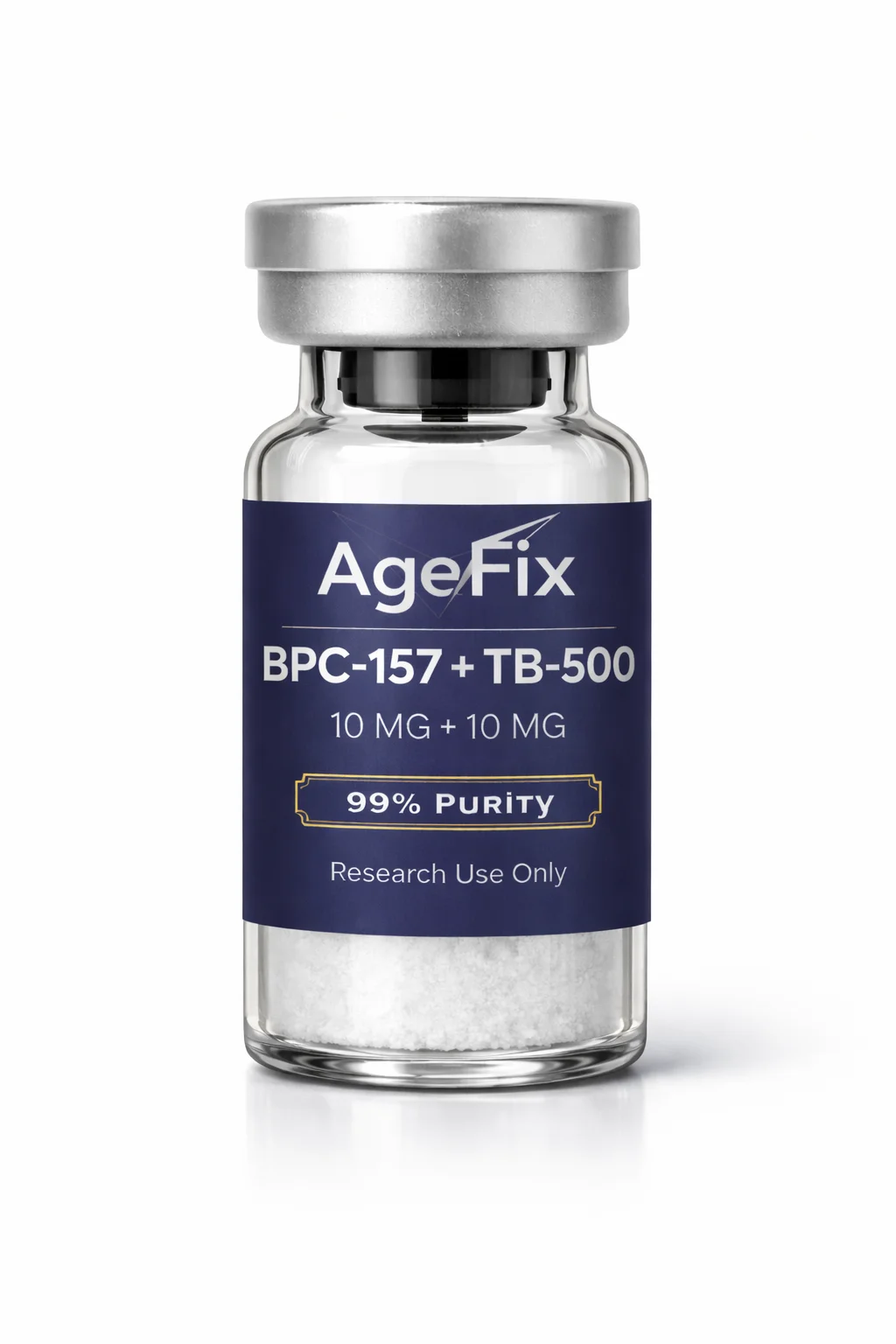
$ 89 / 10mg + 10mg
999 in stock (can be backordered)
The BPC-157 + TB-500 combination pairs two of the most widely studied tissue-repair peptides in preclinical research. Often referred to as the “Wolverine Stack,” this pairing brings together BPC-157’s gastric-peptide-derived healing mechanisms with TB-500’s cell-migration and anti-inflammatory signaling — offering researchers a dual-pathway approach to studying tissue repair, recovery, and regeneration.
BPC-157 (Body Protection Compound-157) is a 15-amino-acid gastric peptide fragment that upregulates growth factors (VEGF, EGF) and modulates the nitric oxide system. TB-500 (Thymosin Beta-4) is a 43-amino-acid peptide that promotes actin polymerization, fibroblast migration, and cytokine modulation. Together, they target complementary repair pathways — BPC-157 focuses on vascular and gut-related healing, while TB-500 supports broader tissue remodeling and inflammation control.
For researchers extending their tissue-repair studies, GHK-Cu offers collagen-remodeling and wound-healing research via copper-peptide mechanisms, while LL-37 provides an antimicrobial and innate-immunity angle on tissue repair.
Each vial contains a balanced 5 mg/5 mg ratio of BPC-157 and TB-500, manufactured in the USA under ISO-certified conditions. Verified to ≥99% purity by HPLC analysis, with endotoxin screening below 0.1 EU/mg. Certificate of Analysis (COA) available upon request. For laboratory research use only.
This peptide blend is supplied in lyophilized (freeze-dried) form to preserve the stability of both BPC-157 and TB-500 components. Store unopened vials at -20°C in a dry, light-protected environment. Reconstitute with bacteriostatic water using aseptic technique when ready for experimental use. After reconstitution, store the solution at 2–8°C and use within 28 days. Avoid repeated freeze-thaw cycles, as thermal cycling can compromise peptide bond integrity and reduce activity of both components. Handle with standard laboratory PPE. For research use only.
BPC-157 was first characterized in the early 1990s at the University of Zagreb by Professor Predrag Sikiric’s research group, while TB-500 (Thymosin Beta-4) was originally isolated from thymic tissue by Allan Goldstein at George Washington University in the 1960s and further characterized through the 1980s. The combination of these two peptides emerged as a research pairing in the 2000s when investigators recognized their complementary tissue-repair mechanisms. BPC-157 has accumulated over 100 published preclinical studies focusing on gastrointestinal and tendon repair, while TB-500 has been studied in more than 70 publications examining wound healing, cardiac tissue remodeling, and anti-inflammatory signaling. Institutions including the NIH, various European universities, and Australian veterinary research centers have contributed to the body of literature on these compounds. This product is intended for laboratory research use only.
Both peptides in this blend are individually verified to ≥99% purity via third-party HPLC analysis, with endotoxin screening below 0.1 EU/mg. The product is manufactured in the USA under ISO-certified conditions, and a Certificate of Analysis (COA) covering both components is available upon request for research documentation.
BPC-157 and TB-500 target complementary tissue-repair pathways — BPC-157 primarily upregulates vascular growth factors (VEGF, EGF) and modulates nitric oxide signaling, while TB-500 promotes actin polymerization and fibroblast migration. Preclinical studies suggest that combining these mechanisms may produce synergistic effects in tissue-repair and recovery models. This product is intended for laboratory research use only.
Each vial contains a balanced 5 mg/5 mg ratio of BPC-157 and TB-500, providing equal amounts of both peptides for controlled experimental design. This standardized ratio allows researchers to maintain consistent dosing across studies investigating dual-pathway repair mechanisms. For laboratory research use only.
We use cookies to enhance your browsing experience, provide personalized content, and improve site performance. For the best experience, please keep your browser up to date — latest browser update.