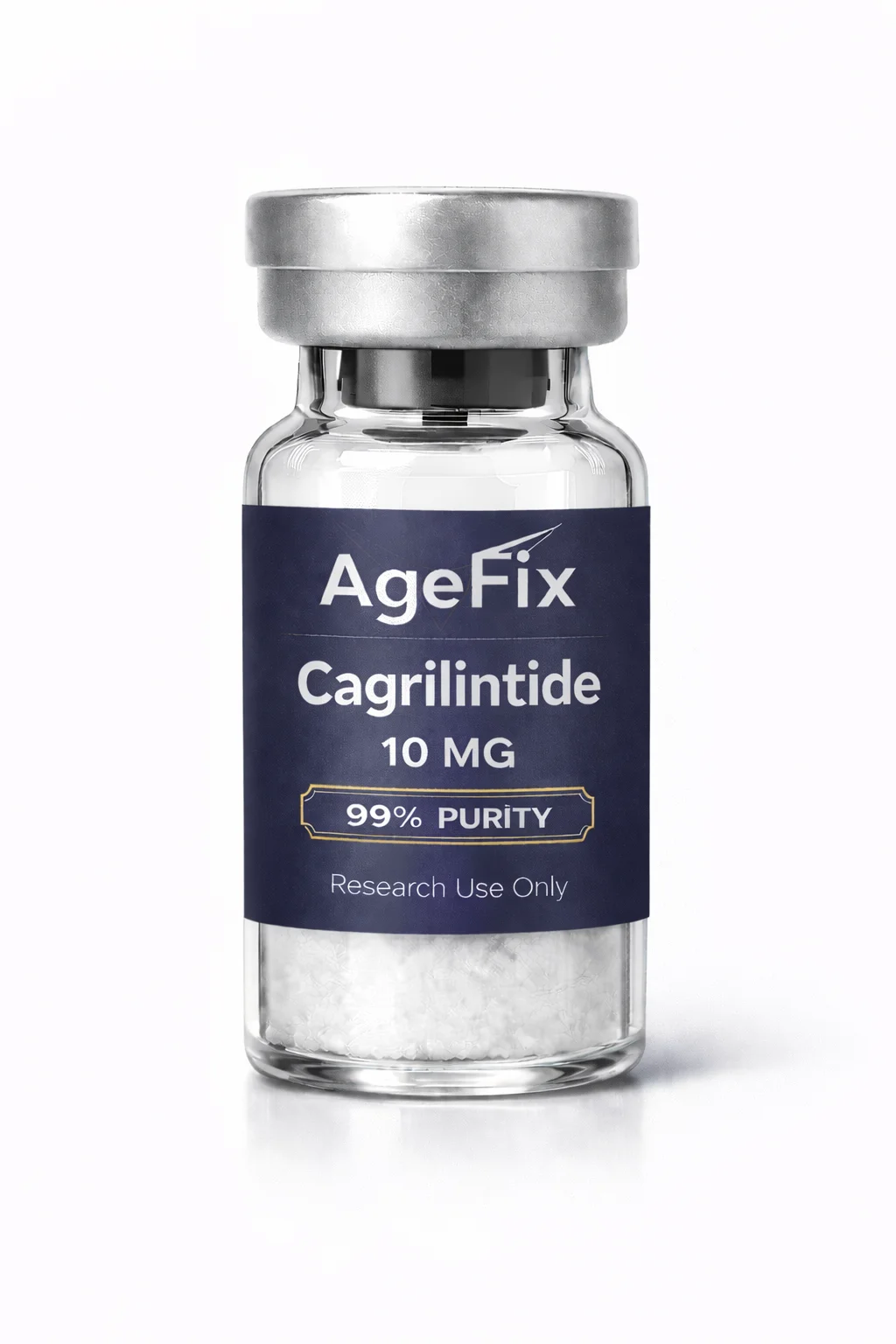
$ 219 / 10mg
999 in stock (can be backordered)
Cagrilintide is a long-acting analogue of the naturally occurring hormone amylin, which is co-secreted with insulin from pancreatic beta cells. Designed for extended receptor activity, Cagrilintide peptide is studied in preclinical and clinical research models for its role in appetite regulation, gastric emptying, and body-weight management. Its prolonged half-life makes it particularly useful for investigating sustained metabolic signaling.
Cagrilintide peptide activates amylin receptors (AMY1, AMY2, AMY3) in the brain’s area postrema and other regions involved in satiety signaling. Unlike native amylin, which is rapidly degraded, Cagrilintide is engineered for weekly-dosing pharmacokinetics in research models. This extended activity profile allows researchers to study cumulative effects on food intake, glucose homeostasis, and energy expenditure over longer experimental periods.
Cagrilintide is often studied alongside GLP-1 receptor agonists for dual-pathway metabolic research. Survodutide and Mazdutide offer dual GLP-1/glucagon agonism, while Retatrutide provides a triple-agonist approach targeting GLP-1, GIP, and glucagon receptors.
Each vial contains Cagrilintide peptide manufactured in the USA under ISO-certified conditions. Verified to ≥99% purity by HPLC analysis, with endotoxin screening below 0.1 EU/mg. Certificate of Analysis (COA) available upon request. For laboratory research use only.
Cagrilintide is supplied as a lyophilized (freeze-dried) powder to ensure maximum stability during storage and transport. Store unopened vials at -20°C in a dry, light-protected environment. Reconstitute with bacteriostatic water using sterile aseptic technique prior to experimental use. Once reconstituted, store the peptide solution at 2–8°C (standard laboratory refrigerator) and use within 28 days to maintain structural integrity. Avoid repeated freeze-thaw cycles, which can degrade acylated peptide bonds and diminish receptor-binding activity. Handle with appropriate laboratory PPE at all times. For research use only.
Cagrilintide was developed by Novo Nordisk as a next-generation long-acting amylin analogue designed to overcome the rapid degradation limitations of native amylin (also known as islet amyloid polypeptide, or IAPP). Native amylin was first identified in 1987 by researchers studying pancreatic beta-cell secretions, and its role in satiety signaling and gastric emptying has since been documented in hundreds of publications. Cagrilintide itself entered clinical investigation in the late 2010s, with Phase 2 and Phase 3 trials examining its effects on body-weight management when used alone and in combination with semaglutide (the CagriSema program). Research has been published in journals including The Lancet, The New England Journal of Medicine, and Diabetes, Obesity and Metabolism. These studies represent clinical-stage research; this product is sold as a research-grade peptide for laboratory investigation only.
Each vial of Cagrilintide is verified to ≥99% purity via third-party HPLC analysis and screened for endotoxin levels below 0.1 EU/mg. It is manufactured in the USA under ISO-certified conditions, and a Certificate of Analysis (COA) is available upon request for research documentation purposes.
Unlike native amylin, which has a very short half-life and is rapidly degraded in vivo, Cagrilintide is engineered for extended-duration receptor activity compatible with weekly-dosing research protocols. This prolonged pharmacokinetic profile allows investigators to study cumulative effects on satiety signaling, food intake, and energy expenditure over longer experimental periods. For laboratory research use only.
Yes, Cagrilintide is frequently investigated alongside GLP-1 receptor agonists in preclinical models exploring dual-pathway approaches to metabolic regulation. The amylin and GLP-1 receptor systems target distinct but complementary satiety and glucose-homeostasis pathways, making them a common pairing in obesity and metabolic research. This product is intended for laboratory research use only.
We use cookies to enhance your browsing experience, provide personalized content, and improve site performance. For the best experience, please keep your browser up to date — latest browser update.