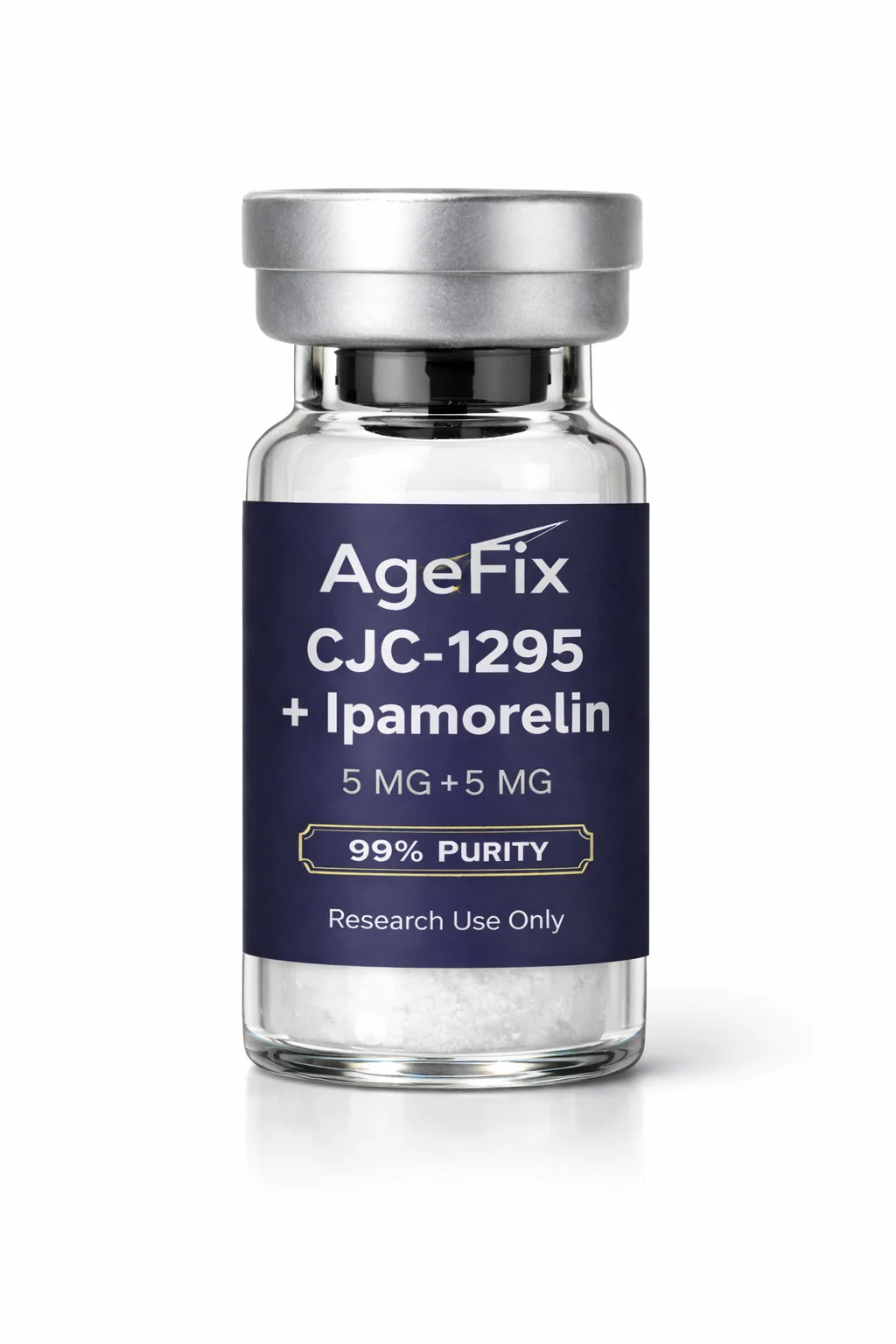
$ 80 / 5mg + 5mg
999 in stock (can be backordered)
The CJC-1295 + Ipamorelin combination pairs a GHRH analogue with a ghrelin-receptor agonist in an even 5 mg/5 mg ratio, creating one of the most well-established growth-hormone-releasing peptide stacks in preclinical research. This dual-pathway approach stimulates GH release through two distinct receptor systems — amplifying the pulsatile GH response beyond what either peptide achieves alone.
CJC-1295 (No DAC) binds GHRH receptors on pituitary somatotrophs, while Ipamorelin activates ghrelin receptors (GHS-R1a) — two independent triggers for GH secretion. In preclinical models, this combination has been studied for producing stronger, more consistent GH pulses while maintaining the body’s natural feedback mechanisms, without significant effects on cortisol or prolactin levels.
For researchers exploring broader GH-axis signaling, Tesamorelin offers a GHRH analogue studied specifically for visceral-fat metabolism, while Sermorelin provides a shorter-acting alternative for pulsatile GH-release comparison studies.
Each vial contains a balanced 5 mg/5 mg ratio of CJC-1295 (No DAC) and Ipamorelin, manufactured in the USA under ISO-certified conditions. Verified to ≥99% purity by HPLC analysis. Certificate of Analysis (COA) available upon request. For laboratory research use only.
This peptide blend is supplied in lyophilized (freeze-dried) form to maintain the stability of both CJC-1295 and Ipamorelin components. Store unopened vials at -20°C in a dry, light-protected environment. Reconstitute with bacteriostatic water using sterile aseptic technique when ready for experimental use. After reconstitution, refrigerate the solution at 2–8°C and use within 28 days to ensure both peptides retain full receptor-binding activity. Avoid repeated freeze-thaw cycles, which can compromise the integrity of both GHRH and ghrelin-receptor-targeting components. Handle with standard laboratory PPE. For research use only.
CJC-1295 was originally developed by ConjuChem Biotechnologies in Montreal during the early 2000s as a stabilized GHRH analogue, while Ipamorelin was first synthesized in 1998 by researchers at Novo Nordisk as a selective growth-hormone secretagogue with minimal cortisol and prolactin effects. The combination of these two peptides became a standard research pairing after studies demonstrated that simultaneous GHRH-receptor and ghrelin-receptor activation produces amplified GH pulses exceeding what either compound achieves individually. Published research on these compounds spans journals including the Journal of Clinical Endocrinology & Metabolism, Endocrinology, and Growth Hormone & IGF Research. Research institutions across North America and Europe have documented the synergistic pharmacology of this dual-receptor approach in GH-axis studies. This product is sold for laboratory research use only.
Each vial is manufactured under ISO-certified conditions in the USA and verified to ≥99% purity via HPLC analysis for both the CJC-1295 and Ipamorelin components. A full Certificate of Analysis (COA) is available upon request, documenting identity, purity, and endotoxin screening for research use only.
These two peptides activate GH release through independent receptor pathways — CJC-1295 via GHRH receptors and Ipamorelin via ghrelin receptors (GHS-R1a). Preclinical research has shown that this dual-pathway stimulation produces amplified GH pulses without significant effects on cortisol or prolactin, making it a preferred combination in GH-axis research models.
The lyophilized peptide should be stored at 2–8°C before reconstitution. Once reconstituted with bacteriostatic water, the solution should be refrigerated and used within the timeframe specified on the Certificate of Analysis. This product is intended for laboratory research use only and is not for human consumption.
We use cookies to enhance your browsing experience, provide personalized content, and improve site performance. For the best experience, please keep your browser up to date — latest browser update.