$ 49 / 10mg
999 in stock (can be backordered)
Epithalon (Epitalon) is a synthetic tetrapeptide (Ala-Glu-Asp-Gly) studied for its ability to activate telomerase — the enzyme responsible for maintaining telomere length during cell division. Originally developed by the St. Petersburg Institute of Bioregulation and Gerontology, Epithalon peptide has been explored in over two decades of research examining cellular aging, telomere dynamics, and lifespan extension in animal models.
Epithalon peptide stimulates the expression of the telomerase reverse transcriptase (hTERT) gene, promoting telomerase activity in somatic cells. Telomere shortening is a hallmark of cellular aging — each cell division erodes the protective caps on chromosomes. By reactivating telomerase, Epithalon has been studied for its potential to extend the replicative lifespan of cells in culture and in vivo models, with some research reporting improved circadian function and melatonin secretion.
Researchers investigating longevity and anti-aging pathways often combine Epithalon studies with FOXO4-DRI, which targets senescent-cell clearance, and NAD+, which supports cellular energy and DNA-repair mechanisms. Thymalin offers a complementary immune-aging angle from the same research institute.
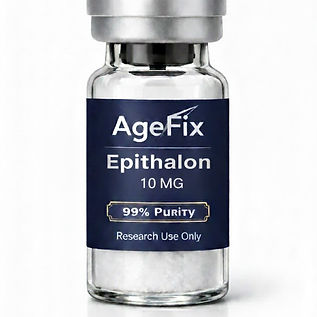
Each vial contains Epithalon peptide manufactured in the USA under ISO-certified conditions. Verified to ≥99% purity by HPLC analysis, with endotoxin screening below 0.1 EU/mg. Certificate of Analysis (COA) available upon request. For laboratory research use only.
Epithalon is supplied as a lyophilized (freeze-dried) powder to preserve maximum tetrapeptide stability. Store unopened vials at -20°C in a dry, light-protected environment. Reconstitute with bacteriostatic water using sterile aseptic technique when ready for experimental use. After reconstitution, store the peptide solution at 2–8°C (standard laboratory refrigerator) and use within 28 days to maintain hTERT-activating efficacy. Avoid repeated freeze-thaw cycles, as thermal stress can degrade the Ala-Glu-Asp-Gly sequence and reduce telomerase-stimulating activity. Handle with appropriate laboratory PPE. For research use only.
Epithalon was developed by Professor Vladimir Khavinson and colleagues at the St. Petersburg Institute of Bioregulation and Gerontology (Russia) beginning in the 1990s. It is a synthetic version of Epithalamin, a polypeptide extract from the pineal gland that Khavinson’s group had been studying since the 1970s for its effects on aging. The tetrapeptide sequence was identified and synthesized to provide a standardized research compound. Published studies on Epithalon span more than two decades and appear in journals including Bulletin of Experimental Biology and Medicine, Neuroendocrinology Letters, and Biogerontology. Khavinson’s group reported that Epithalon activated telomerase in human somatic cells and extended the lifespan of laboratory animals in several studies. Research groups in Russia, the United States, and Europe have further investigated its effects on circadian regulation, melatonin production, and age-related biomarkers. Epithalon remains one of the most referenced peptides in telomere-biology and longevity research. This compound is sold for laboratory research use only.
Epithalon is a synthetic four-amino-acid peptide that activates telomerase by stimulating expression of the hTERT gene. Telomerase maintains telomere length during cell division, and its activation has been studied for potential effects on cellular lifespan and aging markers in preclinical models.
Epithalon is used in longevity research examining telomere dynamics, replicative senescence, circadian rhythm regulation, and melatonin secretion. It is frequently studied alongside other anti-aging compounds like FOXO4-DRI and NAD+.
Each vial is USA-manufactured under ISO-certified conditions with ≥99% HPLC-verified purity and endotoxin screening below 0.1 EU/mg. A Certificate of Analysis (COA) is available. For laboratory research use only.
We use cookies to enhance your browsing experience, provide personalized content, and improve site performance. For the best experience, please keep your browser up to date — latest browser update.