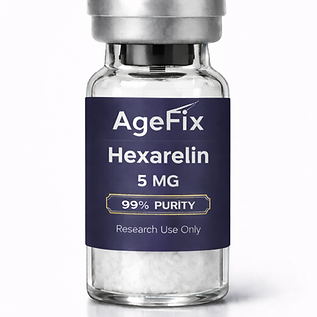
$ 59 / 5mg
999 in stock (can be backordered)
Hexarelin is a synthetic six-amino-acid peptide that targets the ghrelin receptor (GHS-R1a) to stimulate consistent, high-amplitude growth-hormone release. It is considered the most potent GH secretagogue in the GHRP family, producing stronger GH pulses than GHRP-2 or GHRP-6 in comparative studies. Hexarelin peptide is widely used in endocrinology and cardiology research due to its additional cardioprotective properties observed in preclinical models.
Hexarelin peptide binds GHS-R1a with high affinity, triggering robust GH secretion through calcium-dependent signaling in pituitary somatotrophs. Uniquely, Hexarelin also activates CD36 scavenger receptors on cardiac tissue — a pathway studied for its potential role in cardioprotection independent of GH release. This dual receptor profile makes it particularly interesting for research bridging endocrine and cardiovascular signaling.
For GH-axis research, GHRP-2 and GHRP-6 offer lower-potency comparators, while Ipamorelin provides a more selective alternative without cortisol elevation. Combining with CJC-1295 (No DAC) enables dual GHRH + GHRP research.
Each vial contains Hexarelin peptide manufactured in the USA under ISO-certified conditions. Verified to ≥99% purity by HPLC analysis, with endotoxin screening below 0.1 EU/mg. Certificate of Analysis (COA) available upon request. For laboratory research use only.
Hexarelin is supplied as a lyophilized (freeze-dried) powder for maximum long-term stability. Store unopened vials at -20°C in a dry, light-protected environment. Reconstitute with bacteriostatic water using sterile aseptic technique when ready for experimental use. After reconstitution, store the peptide solution at 2–8°C (standard laboratory refrigerator) and use within 28 days to maintain full GHS-R1a and CD36 receptor-binding activity. Avoid repeated freeze-thaw cycles, as thermal cycling can degrade the hexapeptide structure and diminish biological potency. Handle with appropriate laboratory PPE. For research use only.
Hexarelin (His-D-2-methyl-Trp-Ala-Trp-D-Phe-Lys-NH2) was first synthesized in the early 1990s as part of the broader growth-hormone-releasing peptide research program. It was characterized as the most potent member of the GHRP family by researchers including Romano Deghenghi and colleagues in Italy, with early pharmacological studies published in Life Sciences and the Journal of Endocrinological Investigation. A key discovery came when researchers identified Hexarelin’s unique interaction with CD36 scavenger receptors on cardiac tissue, independent of its GH-releasing activity — work published by Bhatt, Bhakta, and others that opened a new avenue of cardiovascular peptide research. Since then, more than 150 peer-reviewed studies have examined Hexarelin’s endocrine and cardiac properties, with contributions from research groups at Italian, Canadian, and American institutions. This compound is sold for laboratory research use only.
Hexarelin is the most potent GH secretagogue in the GHRP family, producing stronger growth-hormone pulses than GHRP-2 or GHRP-6. It also uniquely activates CD36 scavenger receptors on cardiac tissue, giving it cardioprotective research applications beyond standard GH-axis studies.
Hexarelin peptide is used in endocrinology research for GH-release pharmacology, in cardiology research for CD36-mediated cardioprotective signaling, and in comparative studies examining secretagogue potency and selectivity.
Each vial is manufactured in the USA under ISO-certified conditions, verified to ≥99% purity by HPLC, with endotoxin levels below 0.1 EU/mg. COA available upon request. For laboratory research use only.
We use cookies to enhance your browsing experience, provide personalized content, and improve site performance. For the best experience, please keep your browser up to date — latest browser update.