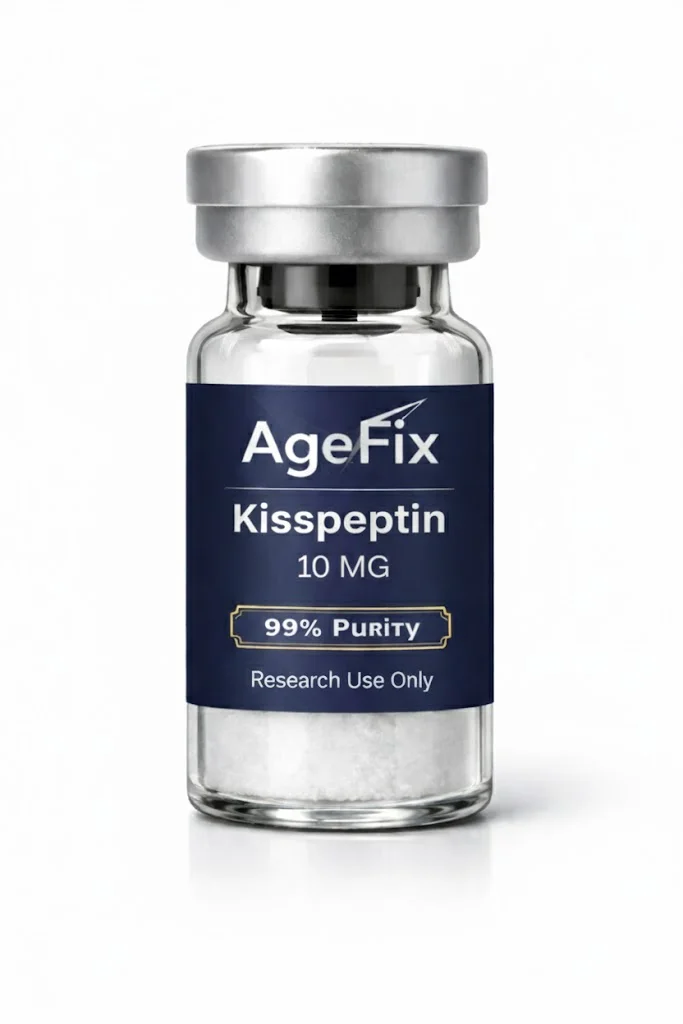
$ 70 / 10mg
999 in stock (can be backordered)
Kisspeptin-10 is a truncated neuropeptide fragment derived from the KISS1 gene product, studied for its pivotal role in stimulating gonadotropin-releasing hormone (GnRH) release from hypothalamic neurons. Kisspeptin peptide is a critical research tool in reproductive endocrinology, where it serves as the primary upstream trigger for the hypothalamic-pituitary-gonadal (HPG) axis — making it essential for studies on puberty, fertility, and hormone regulation.
Kisspeptin peptide binds to the KISS1R (GPR54) receptor on GnRH neurons in the hypothalamus, triggering GnRH secretion and downstream release of luteinizing hormone (LH) and follicle-stimulating hormone (FSH). This cascade is the body’s primary mechanism for initiating and maintaining reproductive hormone signaling. Research has shown that kisspeptin signaling is essential for puberty onset, ovulation, and spermatogenesis in animal models.
Researchers studying reproductive and hormonal pathways often explore Kisspeptin alongside PT-141 for melanocortin-based sexual-function research and Oxytocin for social-behavior and neuroendocrine signaling models.
Each vial contains Kisspeptin-10 peptide manufactured in the USA under ISO-certified conditions. Verified to ≥99% purity by HPLC analysis, with endotoxin screening below 0.1 EU/mg. Certificate of Analysis (COA) available upon request. For laboratory research use only.
Lyophilized Kisspeptin-10 peptide should be stored at -20°C upon receipt to maintain full biological activity and neuropeptide stability. Keep vials sealed and protected from light, heat, and moisture during storage. When ready for use, reconstitute with bacteriostatic water (0.9% benzyl alcohol), allowing the lyophilized powder to dissolve gently without vigorous agitation. Once reconstituted, store the solution at 2–8°C and use within 28 days for optimal receptor-binding performance. Avoid repeated freeze-thaw cycles, as this can compromise peptide folding and reduce KISS1R activation potency. Handle under standard aseptic laboratory conditions. For research use only.
Kisspeptin was first identified in 1996 at the Pennsylvania State University College of Medicine, where the KISS1 gene was discovered as a metastasis-suppressor gene. Its critical role in reproductive biology was established in 2003 when independent research groups at Harvard Medical School and the Institut National de la Santé et de la Recherche Médicale (INSERM) in France demonstrated that loss-of-function mutations in the KISS1R (GPR54) receptor caused hypogonadotropic hypogonadism. This landmark discovery positioned kisspeptin as the master upstream regulator of the HPG axis. Since then, over 2,000 peer-reviewed publications have explored kisspeptin’s roles in puberty onset, ovulation, fertility, and neuroendocrine signaling. Major research contributions have come from institutions including Imperial College London, the University of Western Australia, and the NIH. Kisspeptin-10, the truncated C-terminal fragment, is the most widely used form in research due to its full KISS1R agonist activity and improved stability. All citations pertain to preclinical and laboratory research only.
Kisspeptin acts as the primary upstream signal that triggers GnRH release from hypothalamic neurons, which in turn drives LH and FSH secretion from the pituitary — the essential hormonal cascade controlling puberty, ovulation, and spermatogenesis. Without functional kisspeptin-KISS1R signaling, the entire HPG axis fails to activate in animal models. This product is supplied for laboratory research use only.
Each vial is manufactured in the USA under ISO-certified conditions and verified to ≥99% purity by HPLC analysis, with endotoxin screening confirmed below 0.1 EU/mg. A comprehensive Certificate of Analysis (COA) is available upon request for research documentation and regulatory compliance.
Kisspeptin-10 is a truncated C-terminal fragment that retains full biological activity at the KISS1R receptor while offering improved stability and ease of synthesis compared to the 54-amino-acid parent peptide. Researchers frequently use Kisspeptin-10 because it provides equivalent receptor activation with more predictable pharmacokinetics in experimental models. This compound is designated for research use only.
We use cookies to enhance your browsing experience, provide personalized content, and improve site performance. For the best experience, please keep your browser up to date — latest browser update.