$ 84 / 5mg
999 in stock (can be backordered)
LL-37 is the only human cathelicidin antimicrobial peptide, a 37-amino-acid fragment cleaved from the precursor protein hCAP18. It is one of the most extensively studied antimicrobial peptides in innate immunity research, with over 1,000 published papers examining its broad-spectrum antimicrobial activity, immunomodulatory signaling, and wound-healing properties. LL-37 peptide plays a critical role in the first line of defense against bacterial, viral, and fungal pathogens.
LL-37 peptide disrupts microbial membranes through electrostatic interaction with negatively charged phospholipids, forming pores that compromise membrane integrity. Beyond direct antimicrobial activity, LL-37 modulates immune responses by recruiting neutrophils and monocytes via formyl peptide receptor-like 1 (FPRL1), stimulating angiogenesis, and promoting keratinocyte migration in wound-healing models.
Researchers studying immune defense and tissue repair often pair LL-37 with Thymosin Alpha-1 for adaptive immune modulation, KPV for NF-κB-mediated anti-inflammatory signaling, and BPC-157 for gastric-peptide-based tissue repair.
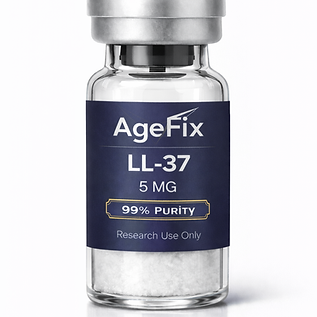
Each 5 mg vial contains LL-37 peptide manufactured in the USA under ISO-certified conditions. Verified to ≥99% purity by HPLC analysis, with endotoxin screening below 0.1 EU/mg. Certificate of Analysis (COA) available upon request. For laboratory research use only.
Lyophilized LL-37 peptide should be stored at -20°C upon receipt to maintain antimicrobial activity and structural integrity. Keep vials sealed and protected from light, heat, and moisture at all times. Reconstitute using bacteriostatic water (0.9% benzyl alcohol), allowing the lyophilized powder to dissolve gently without vortexing or vigorous agitation. Once reconstituted, store the solution at 2–8°C and use within 28 days for optimal peptide performance. Avoid repeated freeze-thaw cycles, as LL-37’s amphipathic helical structure is sensitive to thermal degradation. Handle under standard aseptic laboratory conditions to prevent microbial contamination. For research use only.
LL-37 was first identified and characterized in the mid-1990s by researchers at the Karolinska Institute in Sweden as the sole member of the human cathelicidin family. The peptide is derived from the 18 kDa precursor protein hCAP18, which is processed by proteinase 3 to release the active 37-residue fragment. Since its discovery, LL-37 has become one of the most heavily studied antimicrobial peptides in the scientific literature, with over 1,000 peer-reviewed publications indexed on PubMed. Major research contributions have come from institutions including the Karolinska Institute, the University of British Columbia, the NIH, and UCLA. Studies have characterized its membrane-disrupting antimicrobial mechanism, immunomodulatory signaling through FPRL1, and roles in wound healing and biofilm disruption. LL-37 remains a reference standard in innate immunity and host-defense peptide research. All citations pertain to preclinical and laboratory research only.
LL-37 is the sole cathelicidin antimicrobial peptide expressed in humans, making it a uniquely relevant research tool for studying human innate immune defense mechanisms. Its broad-spectrum activity against bacteria, viruses, and fungi, combined with immunomodulatory and wound-healing properties, gives it a multifunctional profile not found in other antimicrobial peptides. This product is supplied for laboratory research use only.
Each 5 mg vial is manufactured in the USA under ISO-certified conditions and verified to ≥99% purity by HPLC analysis, with endotoxin levels confirmed below 0.1 EU/mg. A full Certificate of Analysis (COA) is available upon request for research documentation and compliance records.
LL-37 is widely used in minimum inhibitory concentration (MIC) assays against gram-positive and gram-negative bacteria, biofilm disruption studies, and membrane-permeabilization experiments. It is also employed in immune-cell recruitment assays and wound-healing scratch models to study its dual antimicrobial and tissue-repair functions. This compound is designated for research use only.
We use cookies to enhance your browsing experience, provide personalized content, and improve site performance. For the best experience, please keep your browser up to date — latest browser update.