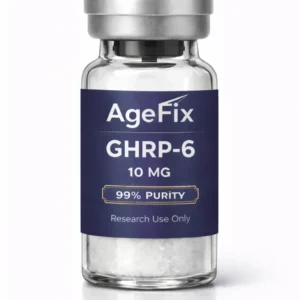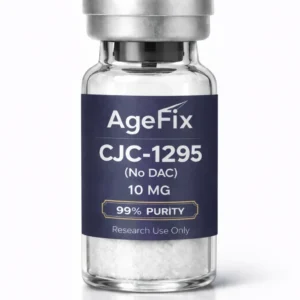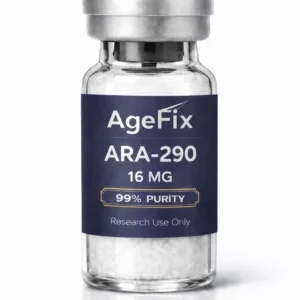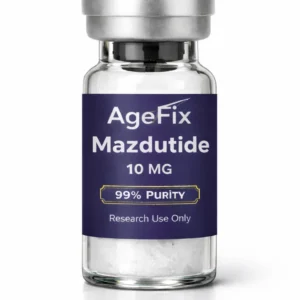
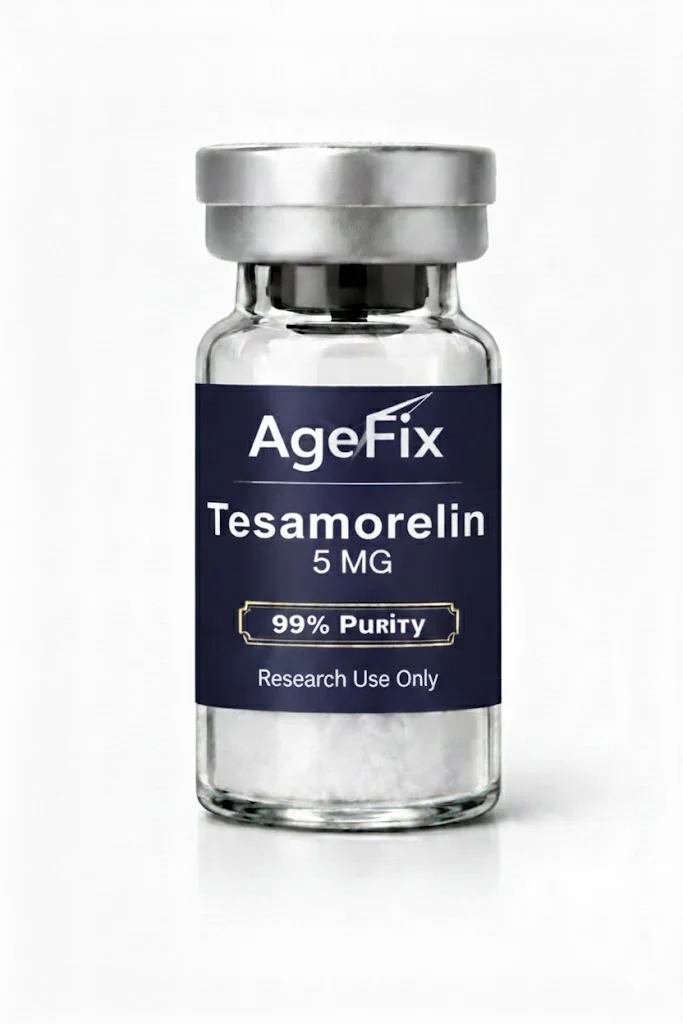
$ 99 / 10mg
999 in stock (can be backordered)
Tesamorelin is a research-grade GHRH analogue consisting of the 44-amino-acid human GHRH sequence with a trans-3-hexenoic acid modification at the N-terminus. This modification provides enhanced resistance to enzymatic degradation, producing consistent, pulsatile growth-hormone release in both cell-based and animal models. Tesamorelin peptide is particularly notable for its extensive clinical research literature on visceral adipose tissue reduction — making it a reference compound in metabolic endocrinology.
Tesamorelin peptide binds GHRH receptors on anterior pituitary somatotrophs, triggering cAMP-dependent GH secretion that preserves natural pulsatile patterns and negative-feedback regulation. The resulting GH elevation stimulates hepatic IGF-1 production, which mediates downstream effects on fat metabolism, protein synthesis, and tissue repair. Research has specifically examined Tesamorelin’s effects on visceral adipose tissue, trunk fat, and liver-fat fraction in lipodystrophy and metabolic models.
Sermorelin offers a shorter-acting GHRH analogue for comparison studies. CJC-1295 + Ipamorelin combines GHRH and ghrelin-receptor activation for dual-pathway GH research. IGF-1 LR3 enables direct downstream IGF-1 receptor studies.
Each 10 mg vial contains Tesamorelin peptide manufactured in the USA under ISO-certified conditions. Verified to ≥99% purity by HPLC analysis, screened for endotoxin levels below 0.1 EU/mg. Certificate of Analysis (COA) available upon request. For laboratory research use only.
Lyophilized Tesamorelin peptide should be stored at -20°C in a sealed container protected from light and moisture for long-term stability. For reconstitution, use bacteriostatic water and gently swirl the vial until fully dissolved — never shake. Once reconstituted, store at 2–8°C (standard laboratory refrigeration) and use within 28 days. Tesamorelin’s N-terminal trans-3-hexenoic acid modification provides enhanced stability compared to unmodified GHRH, but researchers should still prepare aliquots and avoid repeated freeze-thaw cycles to preserve peptide integrity. Always use sterile technique when withdrawing from reconstituted vials. For research use only.
Tesamorelin was developed by Theratechnologies Inc. in Montreal, Canada, as a stabilized GHRH analogue designed to resist enzymatic degradation via its N-terminal trans-3-hexenoic acid modification. Initial preclinical characterization was conducted in the late 1990s, with the compound advancing through a robust clinical research program focused on visceral adiposity. Tesamorelin has been the subject of over 150 peer-reviewed publications indexed in PubMed, with major studies conducted at Massachusetts General Hospital, the National Institutes of Health, and research centers across North America and Europe. It is one of the few GHRH analogues to have undergone extensive controlled metabolic research examining its effects on body composition, liver fat, and cardiovascular risk markers in lipodystrophy models. The compound remains a reference standard for GHRH-analogue pharmacology and visceral fat metabolism research. All referenced work pertains to preclinical and controlled research settings.
AgeFix Tesamorelin is verified to ≥99% purity by HPLC analysis and screened for endotoxin levels below 0.1 EU/mg. Each 10 mg vial is manufactured in the USA under ISO-certified conditions, with a Certificate of Analysis (COA) available upon request for research documentation.
Tesamorelin contains the full 44-amino-acid GHRH sequence with an N-terminal trans-3-hexenoic acid modification that provides enhanced enzymatic stability, while Sermorelin is the shorter 29-amino-acid GHRH fragment. This structural difference makes Tesamorelin particularly useful for sustained GH-release studies and visceral fat metabolism research in laboratory models.
Reconstitute Tesamorelin with bacteriostatic water by gently swirling until dissolved, then store at 2–8°C and use within 28 days. Lyophilized Tesamorelin should be stored at -20°C for long-term stability. This product is for laboratory research use only.
We use cookies to enhance your browsing experience, provide personalized content, and improve site performance. For the best experience, please keep your browser up to date — latest browser update.